Loss of Gravity: The Pieces She Left Behind, Part 3 of 5
My Mother Knew How to Smile
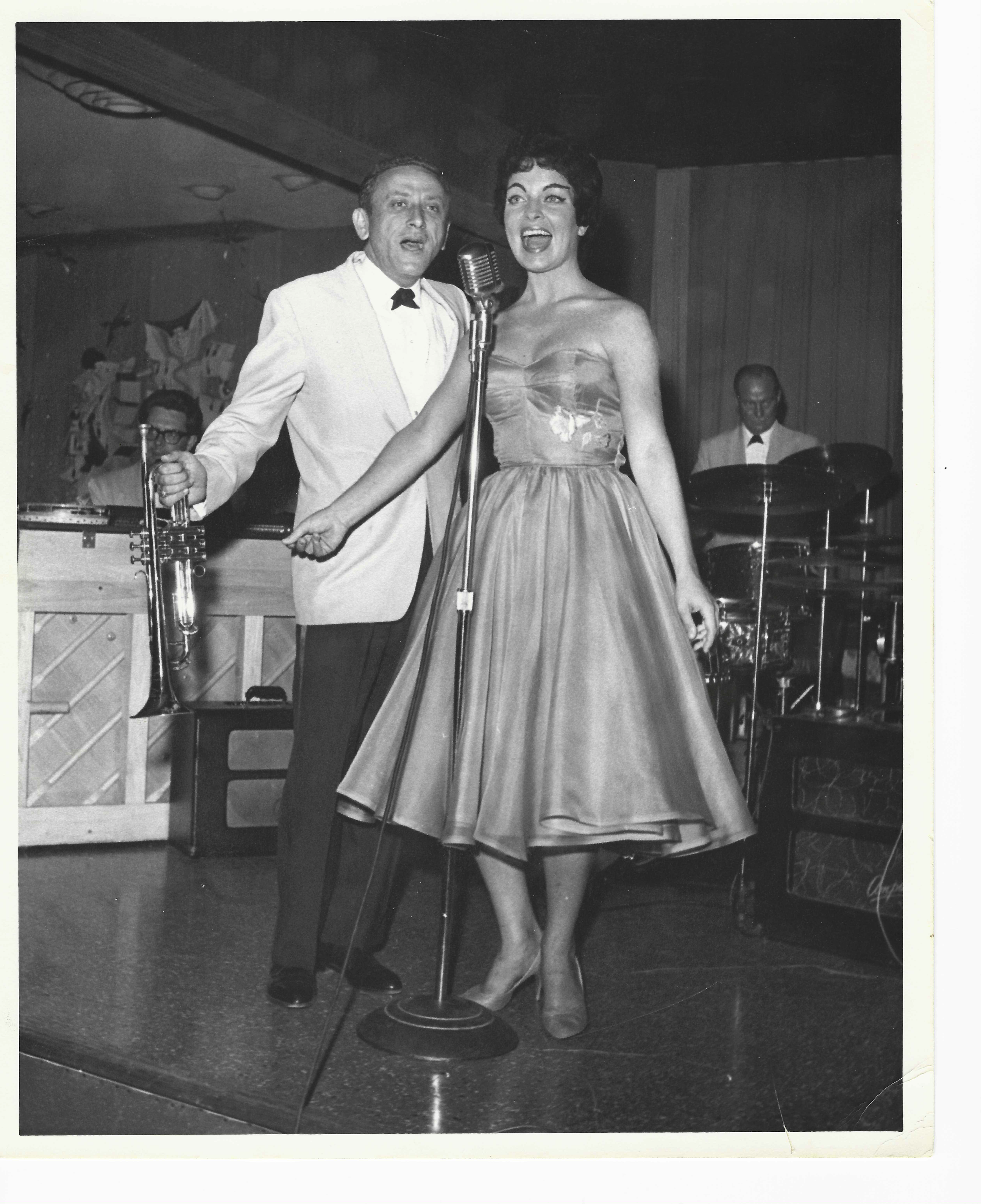
“Reveal yourself, tiny songstress!” That was Barnabas Collins in 2012, yelling at Karen Carpenter on a television screen in Dark Shadows. Every time I think of that line, I think of my mother. Long before she married my father, she had three other husbands and a career that defined her. On her marriage certificates, her occupation was listed simply as “Songstress” - as is should have been. She was local royalty, a woman the newspapers called “Sierra Sue” when they announced that “Local Forces were joining in matrimony.”
There she was, my mother, in satin pink stretch pants (a thing in the 70s), slide Candies heels and a tube top (a thing in the 70s). She would rub baby oil all over (a thing in the…) and stretch herself out on the lawn chair like a cat, trying to darken Scottish skin until everything melded together; freckle, mole or otherwise. We are pale folk, something I have had to contend with my whole life. My mid-western mother whose family came across the Atlantic from a country where they consider summer the one day a year when the sun shines, had absolutely no business roasting on that lawn chair. She would swing her legs over to stand without so much as a wobble on those heels, pick up her cigarette case, fresh box and lighter inside, her lacquered red nails flashing in the sun, and saunter back into the house as though she had simply crossed from one side of the stage to the other.
My mother moved like weather. She arrived, altered the atmosphere, and never seemed aware that the rest of us had noticed like it was the most natural thing in the world.
For my mother, perhaps it was.
The atmosphere changed the moment I dialed his number. Looking back now, that first conversation with Denny was a climb, each of us reaching for the next place to put our hands. It felt surreal. I was not so jaded then, although the shell around me had begun to form, I had made it through a difficult childhood, was working and going to school full-time, and had recently lost my mother.
To those of us who lose a parent early, you don’t always lose just one.
My father had lost his gravitational center and had been launched out into the universe. I was still trying to understand how to live without my mother while watching him learn to exist without his wife.
And somewhere in the middle of all that loss, I found a brother.
He sounded so hopeful. I could almost hear the smile in his voice. He had been waiting through decades to uncover his past and when my mother died, he was allowed a copy of his original birth certificate.
My life had already divided itself into two parts: before her death and after. At the time, I didn’t think twice about how much Denny seemed to know about me. Yet, where he was open, I was hesitant. The shell around me had already begun to form, but there was something else I couldn’t yet name.
My mother was mine.
I know how selfish that sounds. But in those first months after her death, she felt more mine than she ever had while living. She belonged to the me of the now - to my memories, my childhood, my grief. I had only just lost her, and here was a stranger reaching across decades asking me, without actually asking, to share her.
He wanted a piece of his past. I was still trying to hold onto mine.
That first call floated along the surface. The water beneath us was far too deep to enter, and neither of us was ready to find out what waited at the bottom. So we stayed where it was safe.
He was married, had two children, and lived in a state I had never visited. The other brothers had been adopted by different families, scattered into lives of their own, and he didn’t know them well. We traded the facts of our lives - the things two strangers could safely give each other - while everything that had made us family remained beneath us.
Within the week I had received a large envelope with pictures and a two page hand-written letter from Denny.
There she was. My mother. In the photo she sat with a tall, handsome man standing behind her, one hand resting on her shoulder. Three boys stood beside her, stair-stepped by height, while the smallest, still an infant, sat on her lap. For whatever reason, their gaze was upward to the right, as if something just beyond the frame had caught their attention. Even the infant followed their gaze, his small face turned towards whatever the others could see.
I had spent my entire life knowing my mother. I had never known this mother.
The heavens, they were beautiful. Every curl lay perfectly against a clean forehead, collars had been pressed and stillness had been mastered. The edges of each mouth lifted perfectly into a smile as though happiness were the easiest thing in the world.
My mother was perfect, sitting straight - backed without a tube top or slide in high-heeled shoe in sight.
Even then, on her second marriage and fourth child, just months before leaving Iowa, giving up her children and formally changing her name, she looked happy.
But you must remember, my mother was a songstress, a performer and having her photograph taken was part of how she made a living. She understood the camera. She knew how to hold her body, where to place her hands, how to lift her chin, and, most of all, how to smile.
How could I look at a single frozen moment and know whether she was happy? How could I possibly see the hole she was already tumbling into.
When I was ten, I came home from school carrying an envelope I had no intention of giving to my parents. It was ordinary enough - standard paper sized, white, with a clear plastic window across the front. I hid it in my room, hoping it might simply disappear among the other things a ten-year-old accumulates.
My brother eventually betrayed my secret.
Inside were my school pictures. I was embarrassed.
I had arrived at school that morning without my hair brushed. One of my front baby teeth was still in place, stained brown from antibiotics I had been given as a child, and I was fairly certain it had been a few days since my last bath. When my teacher saw me, she did what she could, gathering my unruly hair into two ponytails, one on either side of my head.
The result was less school-picture ready and more Pippi Longstocking.
I remember my mother’s face when she opened the envelope. There was no, Oh, honey, we forgot it was picture day. No wondering how her ten-year-old daughter had made it out the door without her hair brushed, or why it had been left to a teacher to pull the unruly curly hair she shared with her daughter into two uneven ponytails.
She looked at the photograph and then at me. “Why didn’t you brush your hair?”
At ten years old, it never occurred to me that there might have been another question. Why hadn’t someone brushed it for me.
I looked at that photo of my ‘before’ mother for more hours than I care to admit. At twenty, I had only one question. Why? Why didn’t I get that mother?
The mother with the straight back and the perfect smile. The mother whose children had pressed collars and carefully combed hair, all of them gazing happily into the distance as though the ice-cream truck had just driven by.
Why had that mother belonged to them and not to me?
At twenty, I wanted the photograph to give me an answer. I wanted there to be a clean line between the woman sitting in that picture and the mother who would one day look at her ten-year-old daughter’s school photograph and ask why she hadn’t brushed her hair. There wasn’t one. I understand that now.
The woman in that photograph was already standing at the edge of a life she would leave behind. Within months, the fracture growing inside her had already begun to widen. I just couldn’t see it in the photograph because my mother knew how to smile.